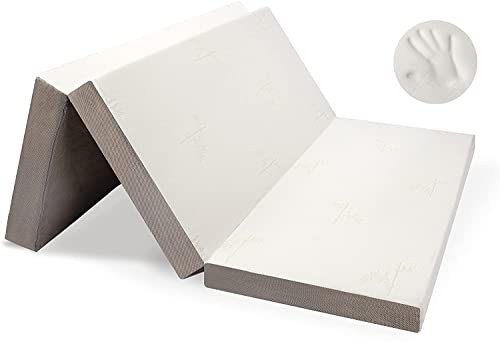
Measure mattress thickness from the bottom of the cover to the highest point of the top panel. Use a rigid tape measure, not a fabric one. Place it against a flat wall at the head of the bed, then measure straight down to the surface the mattress sits on. Do not include pillow tops if they compress unevenly.
Why it matters
Mattress thickness affects how deep your fitted sheets need to be, how well your bed frame supports the mattress, and whether you can safely use guardrails or step stools. A thickness measurement that is off by even an inch can mean sheets that pop off or a mattress that sits too low on a platform bed. Getting the number right helps you buy sheets that fit and ensures your foundation or box spring is tall enough for easy getting in and out of bed.
How to check
Follow these steps for an accurate measurement every time.
- Strip the bed completely. Remove all sheets, mattress protectors, and toppers. You need bare mattress against the support surface.
- Place the mattress against a wall. Slide the head of the mattress flush against a flat wall. This gives you a square reference point.
- Use a rigid tape measure. A metal carpenter’s tape or a yardstick works best. Fabric tape can sag and give you a wrong reading.
- Measure from the support surface. Place the tape measure on the floor, slat, or platform the mattress sits on. Run it straight up the side of the mattress to the very top of the quilted panel. Do not press down into the foam.
- Take three readings. Measure at the center of the head, the center of the foot, and the middle of one side. Average the three numbers. Mattresses can vary by up to half an inch from spot to spot.
Common mistakes
- Measuring with a pillow top included. Pillow tops are often sewn on and can be thicker in the middle than at the edges. Measure at the edge, not the center of the pillow top.
- Using a fabric tape measure. Fabric stretches and curves. Always use a rigid metal tape or a straight ruler.
- Measuring from the floor when the mattress is on a box spring. If your mattress sits on a box spring or foundation, measure from the top of that support, not the floor. Otherwise you get the combined height of the foundation plus the mattress.
- Measuring a new mattress right out of the box. Bed-in-a-box mattresses need 24 to 48 hours to fully expand. Measuring too early gives a low number that will change.
- Including a mattress topper. A topper is not part of the mattress. Measure the mattress alone, then add topper height separately if you need total sleeping surface height.
When a new mattress makes sense
If your current mattress is under 8 inches thick and you sleep on a platform bed, you may find the bed too low for comfortable entry and exit. Many standard bed frames require a minimum mattress thickness of 8 to 10 inches for proper support. If your mattress is older than 8 years, sagging, or causing back pain, replacing it is often the smarter move than trying to fix a thin mattress with a bulky box spring. Browse our mattress collection or read our mattress buying guide to compare thickness options. For hybrid models that tend to be thicker and more supportive, check our picks for the best hybrid mattress.
If you are measuring because your fitted sheets keep slipping off, compare your mattress thickness to the sheet pocket depth. A mattress that is 12 inches thick needs sheets with a pocket depth of at least 14 inches to stay put. For platform beds, confirm that your bed slat spacing is no wider than 3 inches to prevent sagging, especially with thicker mattresses. If you place a mattress directly on slats or directly on the floor, thickness becomes even more important for airflow and moisture prevention.
Frequently asked questions
Do I measure the mattress with or without sheets?
Without sheets. Sheets add fabric thickness and can compress unevenly. Always measure the bare mattress for a true thickness reading.
What if my mattress has a detachable pillow top?
Measure the mattress body without the pillow top, then measure the pillow top separately. Add the two numbers together for total thickness, but use only the mattress body measurement for sheet sizing, because pillow tops compress differently.
Does mattress thickness affect support or durability?
Thickness alone does not determine support. A 10 inch mattress with dense foam and good coils can outperform a 14 inch mattress filled with low density foam. Focus on construction and materials, not just height. For a full overview of standard sizes and depths, see our mattress sizes chart.